A rare blend from four Jamaican distilleries

It is interesting that, after years of worshipping at the altar of single malts, Scotch whisky lovers are rediscovering the joy of blends, with prices for premium examples hitting new heights at auction.
For the most part rum is always blended and has been since the 18th century, although it had probably been done on an ad hoc basis before the British adopted blending wholesale. Simply put, there were two contrasting styles of rum available in the Caribbean: the lighter variation, produced mostly in the new continuous stills (c.1830) and the heavier, more robust pot-still products. (Part of Jamaican rum’s uniqueness is due to the island’s continued preference for the pot still.)
The lighter variations lacked a little depth and bass, the heavy hitters were devoid of top notes, subtly and grace. The answer was to combine the strengths of the heavy and the light, to make a more multifaceted, satisfying drink. Blending gave balance and consistency to the spirit – some heavy pot-still rums are an “acquired taste” on their own, but added in small measure to lighter brethren, they bring multitudes of flavour and depth, creating the complex flavour profiles of today.
In order to create the two Crossfire Hurricanes – Gold and Reserve – bespoke rums from four of Jamaica’s six distilleries were selected. Each one produces significantly different expressions of the spirit, which, when blended, becomes more than the sum of their parts. It is a combination of science, art and a mysterious touch of alchemy (Jamaican rums come with a side order of mystique and myth). Below is the quartet of quality producers that contribute to the final symphony of flavours in both iterations of Crossfire Hurricane.
Hampden Estate
Hampden Estate, only around 20 miles but a world away from the tourist magnet of Montego Bay, is renowned for its closely guarded secret ingredients, dating back to the 18th century (it has been in continuous production since 1753), to produce some of Jamaica’s most characterful rums. Using traditional pot-still distillation and long, natural fermentations, Hampden creates high-ester spirits – packed with sweet, fruity aroma compounds – that brim with tropical fruit, notes of sweet peppers and spice, unmistakable “funk” and aromatic intensity. (Some of it is so intense it is destined to flavour ice-cream and liqueurs rather than be drunk neat). The estate has a total of 89 gnarly wooden fermenter tubs, and it uses a process called “dundering”, where a strange brew of aerated stillage (what’s left in the bottom of the pot still after a distillation run), cane vinegar, fresh molasses and water, known as “muck” and stored in a muck pit, is added to the distillate. It is effectively a highly acidic bacterial soup which, despite looking and smelling like something from a horror film, promotes the production of wildly aromatic esters (up to 1,600 parts per million – the highest on the island). Dundering definitely brings the funk to the party. In the Crossfire Hurricane blend, a sparingly used Hampden adds brightness and lift and a complex character that shouts “Jamaica!”.
Long Pond Distillery
Once mothballed and moribund, not to mention fire-ravaged, the increasing global interest in rum, and Jamaican rum in particular, has given Trelawny Parish’s Long Pond – which dates from 1753 – in the north of the island a very welcome second wind when it began distilling again in 2019. It is a producer that is proud of its jealously protected “secret sauce” – the fermentation here also includes the addition of a pungent “muck” to create that funkin’ for Jamaica feel. The “funk” is an intense, pungent flavour profile characterised by high-ester, overripe tropical fruit notes, such as soured banana, pineapple and mango with a touch of savoury aromas. After a long fermentation process, the tropical funk is concentrated within its double retort pot stills famous for the creation of powerful ester aroma and flavour profiles. Within the Crossfire Hurricane blend, the revived Long Pond contributes its trademark structure, richness and a layered aromatic intensity that gives the rum invigorating depth and dimension.
Worthy Park Estate
Dating back to 1670, Worthy Park Estate, which sits almost in the centre of the island, got into the sugar business in the 1720s and began producing rum commercially in 1941 but after WWII, when there was an oversupply of the spirit, it stopped distilling. It recommenced in 2005, releasing its first of the new-era products in 2007 from a state-of-the art distillery using an 18,000-litre pot still with a double retort made by the venerable Forsyths Ltd in Scotland. It can produce light “quick ferment” rums and both medium- and high-ester expressions – all made wholly from molasses produced on the estate (and piped from the sugar refinery to the distillery along a 1km pipeline). Worthy Park is known for its efficiency, versatility and for creating rums that harmoniously balance fruit (bananas, pineapple), spice (vanilla) and caramel with an enviable clarity of flavour. In Crossfire Hurricane, the smoothness of Worthy Park delivers balance and refinement, knitting the blend together with structure and finesse.
Clarendon Distillery
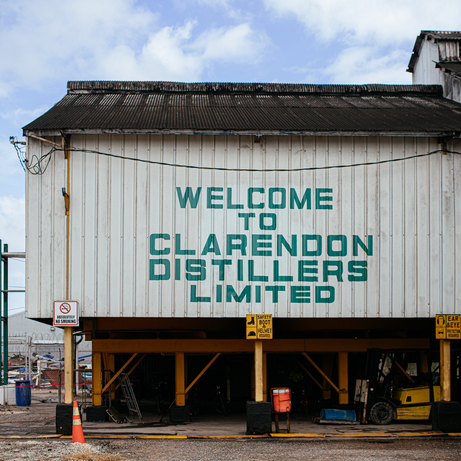
Clarendon Distillery, dating from 1949, sits just 5km inland from Jamaica’s South Coast. Its array of stills (two pots and a column) means that it is another of Jamaica’s versatile rum producers, crafting distillates that cover a wide spectrum of styles. From the pot stills, lighter rums are given a speedy 24-hour ferment in steel tanks, and the heavier expressions are fermented for up to a month in wooden tuns, producing a drink with satisfying body and warmth. The column still, installed in 2010, is capable of producing three different weights of rum, depending on the distilling configuration and fermentation time. Clarendon brings significant depth to the Crossfire Hurricane blend, a solid underpinning to the lighter, more aromatic elements.